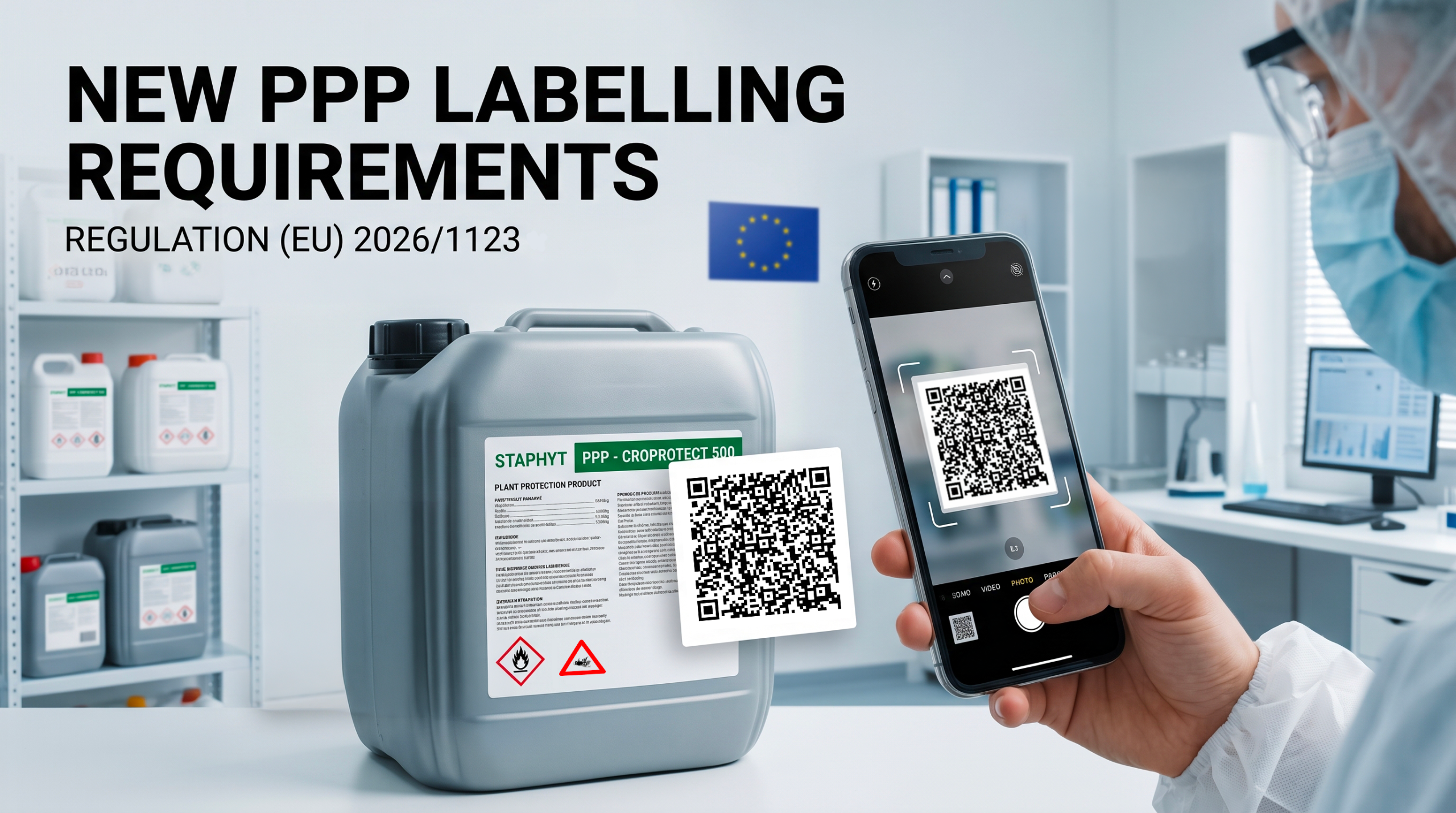
Our experts provide you with an update on the newly published, which changes the labelling requirements for Plant Protection Products across the European Union.
Published in the Official Journal on May 27, 2026, the new Regulation (EU) 2026/1123 repeals the former Directive 547/2011. It introduces a modern, comprehensive system of standard phrases directly linked to risk assessments and mandates the use of both physical and digital labels.
Below is a detailed breakdown of the main topics, key changes, and the strategic roadmap to ensure your product portfolio remains compliant.
-
The Introduction of the Digital Labelling
A major shift in this regulation is the mandatory requirement for a digital label alongside the traditional physical label.
- The digital label must contain the exact same elements as the physical label and perfectly reflect the content of the granted authorization. So if a label is digitized now (so, according to the old requirements), it may need to update later according to the new regulation.
- Additional information to the physical label can be included digitally, provided it complies with the product’s authorization.
- The digital label must be accessible via a data carrier (such as a QR code or a barcode) printed on the physical product label.
If the QR code or barcode already exist it is not needed to create a new one.
- Access must be entirely free of charge and must not require the user to create an account.
- If a product is withdrawn from the market, its digital label must be immediately deactivated or display a clear statement indicating the withdrawal.
- Benefits: This digital transition improves overall readability, provides clear compliance use instructions, and directly supports precision agriculture through data transfer and reduced dose management.
-
General Label Content Updates (Annex I)
The physical label itself will require new mandatory information to be displayed:
- Safeners and Synergists: Labels must explicitly list the names and concentrations of all approved safeners and synergists present in the formulation.
- IPM Statement: All products intended for professional use must feature the specific phrase: “To be used in accordance with the general principles of integrated pest management”.
- Precision Farming: Labels may now include specific allowances for applying a reduced amount of product per hectare when utilizing precision application equipment.
- Parallel Trade: Labels for parallel trade must include the permit number, the details of the permit holder, and the original manufacturer’s batch number.
-
Safe Disposal Phrases (Annex II)
New standard phrases (SD) dictate how PPPs and their containers must be disposed of:
- SD 1: “Do not re-use the container.” This phrase is universally assigned to all PPPs.
- SD 2: “To protect the aquatic environment including groundwater, do not clean application equipment near surface water.” This is assigned to products classified as hazardous to the aquatic environment.
- SD 3: “Rinse container with water three times before disposal.” This is strictly assigned to washable containers.
-
Hazard Communication and The New Bee Pictogram (Annex III)
The regulation updates specific hazard communications (RSh) and introduces strict new visual warnings for pollinators:
- RSh 1: “May cause photosensitization” (assigned if evidence exists or if the concentration is w/w or higher).
- RSh 2: “Contact with vapour causes skin burns and eyes damage and contact with liquid causes freezing” (specifically for liquefied gases)
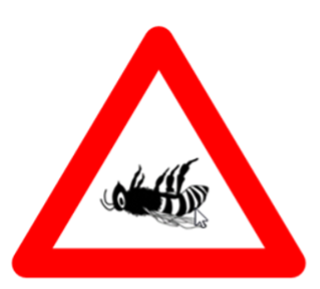
- RShb: “Hazardous to bees” – This phrase is triggered if the LD50 is µg/bee OR if any specific bee mitigation phrase (SPb) is triggered on the label.
- New Pictogram: Any product triggering the RShb phrase must carry a new, mandatory red-bordered triangle pictogram depicting a dead bee:
-
Micro-organisms and Mitigation Measures (Annex IV and V)
The new regulation comprehensively categorizes risk mitigation measures to protect users, bystanders, and the environment:
- Micro-organisms (RSMo): All PPPs containing micro-organisms must carry a precautionary sentence warning of potential sensitizing reactions: “Contains a micro-organism. It may have the potential to cause sensitising reactions.”
- Restrictions of Uses (SRu): These phrases impose limits such as temporal/growth stage restrictions (SRu 1), specific soil/surface bans (SRu 2), and restrictions on steep areas to avoid run-off (SRu 3).
- Protecting Bees (SPb 1 to 5): Includes specific directions such as applying only after daily bee flights, avoiding application on flowering weeds, or covering colonies.
- Other Standard Phrases: The regulation provides specific codified phrases for Operator and Worker Protection (SPo 1-6), Bystanders and Residents (SPbr), Environmental Protection (SPe 1-4), Resistance Management (SPa), Rodenticides (SPr 1-2), and Seed Treatments spanning from the treatment phase (Sts 1-4) to the sowing phase (Sss 1-7).
-
Transition Rules and Critical Deadlines
Based on the latest exchange with DG SANTE (July 15, 2026), managing the transition timeline is critical for maintaining market access:
- January 1, 2028 (The Application Date): The new regulation officially applies to all new authorizations, renewals, and any modifications of an existing label submitted after this date. Submissions made prior to 2028 will continue under the old 547/2011 rules for the time being.
- The “Amendment” Trigger: If a pre-existing label requires an amendment after January 1, 2028 (e.g., due to a new CLP classification, adding a use, or new restrictions), it immediately triggers compliance with the new rules, requiring both the new physical phrases and the digital label.
- January 1, 2030 (The Hard Deadline): By this date, 100% of PPP labels on the market must include the newly required phrases and a digital label.
Important Strategic Action: There will be no automatic relabelling or blanket administrative amendments issued by Member States. Updating labels implies a formal review by the Competent Authority to reflect domestic authorizations. Because the EU does not prescribe a universal administrative procedure for this, Staphyt will proactively contact the Competent Authorities of each individual Member State to define their specific national procedures (e.g. minor amendments vs. renewals) to ensure full compliance by 2030.
We are fully prepared to assist you in mapping your portfolio, assessing which products will trigger the new bee pictogram or mitigation phrases, and coordinating with Member States to secure your compliance ahead of the deadlines.
Contact our team to discuss your project: contact@staphyt.com