Biocides and REACH Regulatory overview: October 2026
Dive into our team’s expertise on the Biocides and REACH markets.
Once a month, our experts will gather all the news and updates in Biocides and REACH markets. They will select major news to help you navigate in the regulations framework.
For a more comprehensive review, we offer a Regulatory Watch subscription. Don’t hesitate to contact us.
Stay up to date by subscribing!
BIOCIDES
1- Ethanol: draft approval regulation for PT1, PT2, and PT4 now available !
The draft Commission Implementing Regulation approving ethanol for Product Types 1, 2 and 4 in the EU has recently been published. The proposed approval date is 1 May 2028.
This draft approval Regulation will need to be confirmed in the Standing Committee on Biocidal Products.
Companies need to contact relevant Competent Authorities now, as a priority, to confirm that they will accept their applications for assessment, and to start preparing their dossiers as soon as possible.
Staphyt can contact authorities on your behalf, and support you throughout the entire authorisation process. Starting with the Data Gap Analysis (DGA) and Preliminary Risk Assessments (PRA), and on through the subsequent steps towards product authorisation.
Contact us today to ensure timely dossier preparation and a smooth and reliable pathway to product authorisation. We can also assist you, where relevant, to explore dossier-sharing opportunities with our partners.
2- Key Regulatory Points from WG I-2026 Final Public minutes
APCP : Packaging Material Assessment & “Water-Based” Read-Across for Biocidal Products
- Focus on Container-Product Interaction: Packaging assessments under BPR primarily examine physical integrity and chemical compatibility during storage. Key requirements include no leakage, no container degradation/dissolution, functional dispensers/sprayers after storage, and maintaining product specifications.
- Minor Changes vs. Integrity Failures: Superficial packaging changes (such as slight deformation) may be acceptable if product performance and safety remain unaffected. However, clear integrity failures—like cracking or dispenser malfunctions—will lead to non-compliance.
- Debate on “Water-Based Formulations”: The Working Group discussed defining “water-based formulations” for packaging waiver read-across. Current guidance allows broad plastic read-across for water-based products, but members noted that small solvent fractions, surfactants, or oxidizers can induce swelling or stress-cracking in plastics.
Next Steps: No final consensus was reached on a strict definition for “water-based formulations.” A dedicated subgroup (including NL, FR, BE, DE, and AT) has been established to examine criteria such as solvent thresholds and ADR transport classification principles. Until new guidance is agreed upon, water-based read-across claims will be evaluated cautiously on a case-by-case basis.
EFFICACY – Determination of the application rate for wipes
This issue emerged during the recent case-related discussion, when it became clear that the test area wetted by the test wipe was calculated incorrectly. As a result, when the application rate (number of wipes) is based on EN 16615, more wipes are likely needed to wet the surface. If the application rate was derived using an incorrect calculation,eCAs will be allowed to correct the calculation during the commenting/trilaterals step.
In case the application rate after recalculation leads to unacceptable risk, it is advisable to perform a wetting test (preferably according to the DIN SPEC 13285 standard).
ENVIRONMENT – Harmonised LoEP for pyrethroid metabolites
SECR reminded the ENV WG that the harmonised LoEP for pyrethroid metabolites are to be used, which has been agreed at BPC-55. The agreement is also listed under TAB ENV 272
ENVIRONMENT – Appendix I: List of TAB entries for confirmation by WG members PT02 and PT04 Environmental exposure assessment of volatile substances from disinfection of small surfaces using RTU pre-soaked wipes or ‘spraying & wiping’ (AHEE-2, WG-I-2026)
Exposure to wastewater (STP) and air is considered negligible and the environmental risk assessment can be addressed qualitativelyfor products that meet all of the following conditions:
- The products are intended for small-scale surfacedisinfection in PT02 and/or PT04.
- Application methods are spraying & wiping, where wiping follows shortly after spraying, or the use of ready-to-use (RTU) pre-soaked wipes.
- Wipes are intended for single useonly (no rinsing or reuse possible).
- Wipes are discarded after use as solid waste.
- The applied active substances are volatile, with a vapour pressure ≥ 0.01 kPa at 293.15 K/20ºC (as defined in Directive 2010/75/EU).
- The product does not contain any substances of concern (at levels) that would trigger the need for a quantitative environmental risk assessment.
Are any of these points relevant to your products or regulatory strategy? Get in touch with our expert team to discuss the implications for your business and the next steps to take.
REACH
1- UK opens technical consultation on the Alternative Transitional Registration Model (ATRm)
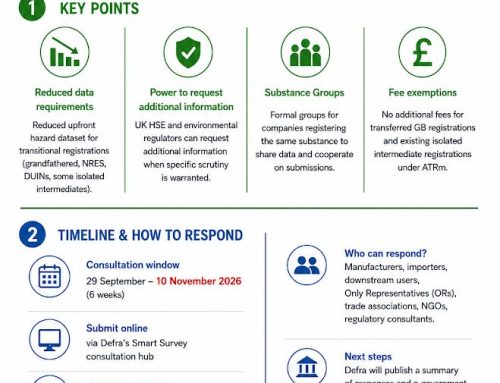
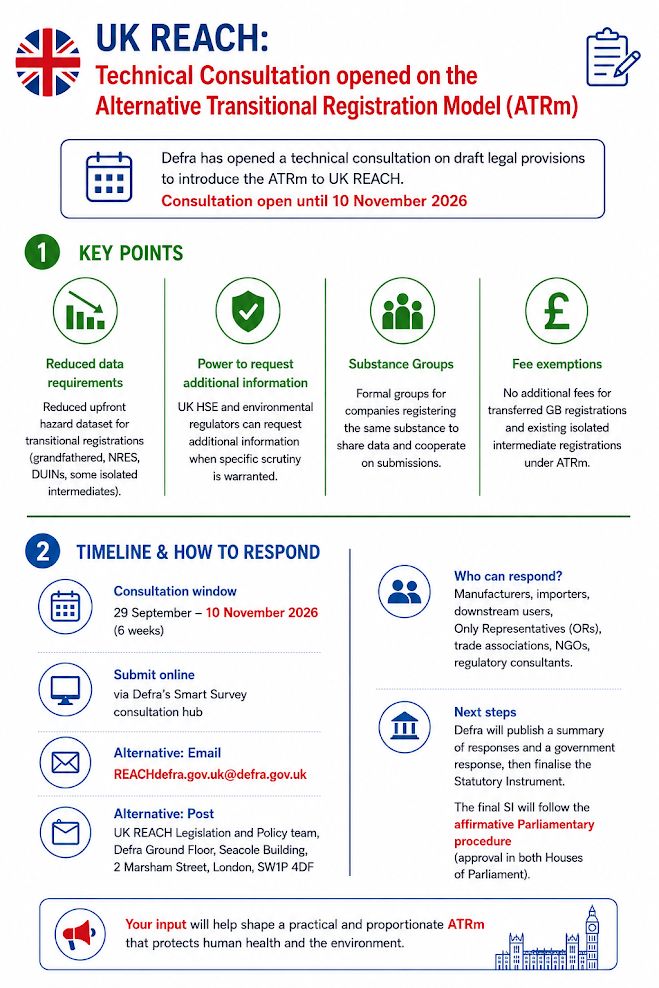
The Department for Environment, Food and Rural Affairs have opened a technical consultation seeking comments on their draft legal provisions to introduce the ATRm to UK REACH. The consultation will be open until 10th November 2026 and affected parties are encouraged to provide comments. As part of the consultation proposed amendments to the legal text of UK REACH have been presented.
Consistent with previous information given on ATRm, the model willseek to reduce data requirements for transitional chemical registrations (encompassing grandfathered registrations, New Registrations of Existing Substances [NRES], Downstream User Information Notifications [DUINs], and some isolated intermediates). It would also give the power to request additional information fromUK HSE and environmental regulators when specific regulatory scrutiny is warranted. The draft amendments introduce formal substance groups, where companies registering the same substance could share data and cooperate with registration submissions in a similar fashion to the Joint Submissions found in EU REACH. Finally they have proposed fee exemptions, there would be no additional registration fees for transferred GB registrations and existing isolated intermediate registrations under ATRm.
The consultation window is open from 29 September to 10 November 2026, stakeholders should respond online via DEFRA’s Smart Survey consultation hub. Once the consultation window closes a summary of responses will be published and the UK government will provide a formal response. From there Parliamentary procedure will commence where a draft legislation will be submitted for approval by Parliament before being enacted into law.
2- European Chemicals Agency committee of Risk Assessment (RAC) applies new Endocrine Disruption criteria
For the first time, the new criteria for the classification of hazardous substances as Endocrine Disruptor for the Environment has been applied to a hazardous substance.
In early September RAC adopted its opinion on Propyl 4-hydroxybenzoate (also known as Propyl paraben) and recommended classification as Endocrine Disruptive for the Environment.for Category 1. Over the next couple of months the opinion will become available on ECHA website and transmitted to the EU Commission for further discussion.
This is an important update applicable across the chemical industry signalling that as the new criteria is applied we will begin to see more Endocrine Disruption Classifications being confirmed. Companies should confirm whether any of their substances are at risk of endocrine disruption.
CROSS DISCIPLINE
1- Northern Ireland will apply EU PFAS limits for PPWR going forwards.
The Department of Agriculture, Environment and Rural Affairs (DAERA) has confirmed that current PFAS limits under the EU Packaging and Packaging Waste Regulation (PPWR) will apply in Northern Ireland from 12 August 2026.
The PPWR was adopted by the European Parliament and came into force on 11 February 2025. While Northern Ireland is no longer part of the EU post-Brexit, under the Windsor Framework, they will still adopt some EU regulations to permit free movement of goods between Northern Ireland and Republic of Ireland. Many aspects of PPWR will therefore apply to Northern Ireland.
Companies who import packaging into Northern Ireland or export out of Northern Ireland should consider whether their packaging meets the PPWR PFAS restrictions.
2- Regulatory Update: ECHA’s Risk Assessment Committee (RAC) Meeting highlights
The ECHA’s Risk Assessment Committee (RAC) adopted several key opinions during its September meeting:
- Glyphosate: The committee concluded that glyphosate does not warrant classification as a carcinogen, re-confirming its 2022 opinion. This follow-up evaluation was conducted at the request of the European Commission after reviewing new data from the Global Glyphosate Study regarding potential carcinogenic effects.
- Spearmint Oil: Adopted an opinion regarding the environmental classification of the extract.
- Rosins and Derivative Extracts: Adopted an opinion concerning the reprotoxic classification of this pine tree extract.
- Paraben (Propyl 4-hydroxybenzoate): Adopted an opinion on its endocrine-disrupting properties for the environment.
In addition to these opinions:
- The committee discussed proposed Occupational Exposure Limits (OELs) for lithium compounds.
- Members agreed on the internal working procedure for its new responsibilities under the Drinking Water Directive.
Next events
DRINKING WATER DIRECTIVE WORKSHOP 21-22 OCTOBER 2026
If you are attending the ECHA DWD Workshop in Helsinki 21st and 22nd October then Staphyt and Bird and Bird warmly invited you to a:
Drinks Reception and networking opportunity – “Afterwork” 21st Oct
At Bird and Bird’s Helsinki offices (close to the ECHA site).
- Are you ready for the EU DWD?
- Are products in your portfolio at risk?
- What is required? – Timelines? Costs? Are there consortia you can join?
This is your opportunity to question the unique combination of a leading European consultancy and the only European law firm specialising in regulatory affairs – with no charge and no obligation.
Please come with any question about the practicalities of fulfilling the DWD requirements.
Please contact Benjamin Heal to express your interest in participating and to receive directions to the venue.
Whether you need assistance about compliance, product registration or any other regulatory issue, our experts are here to provide support: Aviron-Violet Sophie, Elena Campagnoli, Benjamin Heal, ALESSANDRO CASELLATO, Hélène Detrimont, George Leathley
Contact us contact@staphyt.com or visit our website : staphyt.com