What Global Companies Need to Know Before Registering Products in the United States
Breaking into the US agrochemical and crop protection market makes sense on paper. The volume is massive, the margins hold up, and the distribution channels are well established. But the regulatory complexity in the US operates at a different level entirely, and companies that underestimate that find out the hard way what it means in delays, rework, and costs that could have been avoided.
The EPA is not the CIBRC. It is not the Ministry of Agriculture in Beijing. It is not any agency you have likely dealt with before.
Why the US Regulatory System Works Differently
Most companies arrive at the US market with the logic that they have already navigated regulatory processes in other countries and know how this works. The problem is that every jurisdiction has its own requirements, and what worked in China, India, or the EU does not translate directly to the United States.
In the US, beyond safety and efficacy, companies have to deal with:
- Data requirements specific to each product category
- Data citation and compensation processes
- Ongoing reporting obligations to the EPA
- Registration of new active ingredient sources
- Requirements for registering new active ingredients
- Specific requirements for formulations and commercialization
Missing any of these can stall the process by months or years.
Data Compensation: The Topic That Trips Most Companies Up
One of the most common stumbling blocks for international companies is the data compensation mechanism. Most organizations understand the basics of registration, but how data can actually be used, cited, and compensated in practice is a different story.
This matters because it directly affects the cost of the process and the regulatory risks involved. Companies that go in without understanding data compensation tend to underestimate their budget or build an entry strategy that runs into trouble later.
What Needs to Be Settled Before Submission
A successful US registration starts long before any document reaches the EPA. Some questions need clear answers during the planning phase:
Which studies are required for your product category? Does the data compensation mechanism apply to your situation? What is the most appropriate regulatory pathway? What are the legal responsibilities tied to commercialization in the US?
Companies that come in with those answers already tend to move faster, with fewer surprises along the way.
The Advantage of Understanding More Than One Market at Once
What works in Europe can be completely different from what the US requires. And what is approved in the US may need an entirely different approach in the next jurisdiction you want to access.
Having support from people who can connect different regulatory systems, legislation, and market entry strategies cuts down on rework and speeds up access. The regulatory expertise of SciReg in the United States combined with Staphyt’s global presence offers exactly that: the ability to turn international regulatory complexity into clearer paths for product development and expansion.
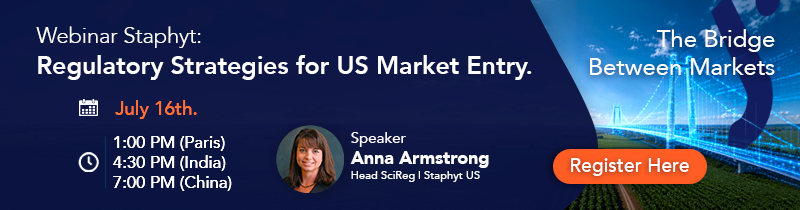
Webinar: Regulatory Strategies for US Market Entry
To help Chinese, Indian, and international companies navigate the regulatory landscape of the US market, SciReg by Staphyt is hosting the webinar Regulatory Strategies for US Market Entry.
The session is led by Anna Armstrong, Team Lead at SciReg by Staphyt, with extensive experience in pesticide research, development, and registration in the United States.
When:
🇮🇳 4:30 PM
🇨🇳 7:00 PM
🇫🇷 1:00 PM
During the webinar, participants will cover:
- Data requirements for EPA registration
- How data citation and data compensation work
- Regulatory reporting obligations
- Registration of new active ingredient sources
- Regulatory strategies for US market entry
The session closes with a live Q&A for anyone who wants to dig into specific cases.
If your company is evaluating opportunities in the US, it is far better to have these answers before you start the process than to figure them out in the middle of it.
Register for the webinar and find out how to build a stronger regulatory strategy for the US market.